
A shopping center parking lot has a bigger job than simply giving customers somewhere to park.
It is often the first part of the property a customer experiences. It handles cars, pedestrians, delivery trucks, employees, shopping carts, waste collection vehicles, and service vehicles throughout the day.
When the pavement is smooth, clearly striped, and well maintained, most people barely think about it.
When it is full of potholes, cracks, standing water, faded markings, or damaged asphalt, everyone notices.
For Bay Area shopping center owners and property managers, parking lot maintenance is also a long term property management issue. Waiting until pavement starts failing throughout the property can turn smaller maintenance needs into a much larger capital project.
This is particularly relevant in 2026. The Metropolitan Transportation Commission reports that the Bay Area has approximately 44,000 lane miles of local streets and roads. The region’s latest Pavement Condition Index score is 67 out of 100, which MTC classifies as “fair.” The regional score has remained at 67 for 10 consecutive years. While those numbers measure public roads rather than private shopping center parking lots, they provide useful context about the aging pavement conditions found throughout the Bay Area.
At the same time, retail properties remain valuable commercial assets. National retail availability was only 4.9 percent in the second quarter of 2026, while average asking rents increased 2.4 percent year over year, according to CBRE. In a market where retailers continue to compete for quality locations, the physical condition of a shopping center still matters.
So what should you do when your shopping center parking lot starts showing its age?
Here is what Bay Area property managers should know.
A shopping center is not an empty commercial property where a paving crew can simply close the lot and work without interruption.
Retail properties have customers coming and going throughout the day. Stores need deliveries. Employees need parking. Restaurants may experience busy lunch and dinner periods. Grocery stores can have traffic from morning until late at night.
That means shopping center asphalt paving requires both pavement expertise and careful planning.
A paving contractor needs to consider:
Customer access
Tenant access
Delivery schedules
Pedestrian traffic
Employee parking
Loading areas
Fire lanes
Accessible parking areas
Main entrances and exits
Peak shopping hours
High traffic drive lanes
Drainage
Existing pavement condition
The best solution for one part of the parking lot may also be different from another.
A lightly used row of parking spaces does not experience the same traffic as the main entrance. A loading area behind a grocery store has different demands than customer parking in front of a small retail tenant.
Good commercial asphalt paving starts with understanding how the property actually operates.
Property managers do not need to be paving experts to recognize that something is changing.
Regularly walking the property can help identify pavement problems while they are still manageable.
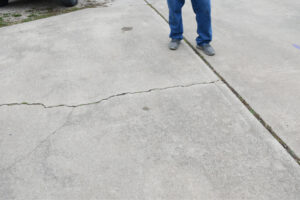
Cracking is one of the most obvious signs of asphalt deterioration.
Not every crack means the parking lot needs to be replaced.
Some cracks may be candidates for crack sealing or other preventive pavement maintenance. Extensive cracking, however, can indicate more significant deterioration.
The Federal Highway Administration recognizes crack sealing as a preventive maintenance technique. FHWA research notes that sealing and filling asphalt cracks can help reduce water infiltration into the pavement structure and extend pavement life when used under appropriate conditions.
Property managers should watch for:
New cracks appearing quickly
Cracks becoming wider
Multiple cracks connecting
Cracking around drains
Cracks surrounding previous repairs
Vegetation growing through cracks
Water collecting near cracked pavement
These are good reasons to have the area evaluated rather than simply waiting to see what happens.

When interconnected cracks begin resembling the scales on an alligator’s back, the issue may be more serious than an isolated surface crack.
This type of distress can be associated with pavement failure beneath the surface.
Simply putting crack sealant over a structurally failed area is not the same as repairing the pavement.
A contractor should evaluate the area and determine whether localized removal and replacement or another repair is appropriate.
A pothole in the middle of a shopping center is difficult to ignore.
Customers drive around it. Water collects inside it. Tenants complain about it. Eventually someone puts a traffic cone next to it.
Potholes should also be viewed as information.
Rather than only asking, “How do we fill this hole?” property managers should ask why the pavement failed in that location.
There may be cracking, water infiltration, weakened pavement, drainage problems, or other conditions contributing to the damage.
After the next Bay Area rain, walk the parking lot.
Where does the water go?
Small puddles immediately after rain are one thing. Areas that repeatedly hold water deserve attention.
Look around:
Catch basins
Curbs
Loading zones
Low areas
Previous patches
Main drive lanes
Parking lot entrances
Building edges
Water can contribute to pavement deterioration when it enters cracks and reaches vulnerable pavement layers.
Drainage should therefore be considered as part of the overall pavement evaluation rather than treated as an unrelated problem.
Asphalt condition is only part of parking lot maintenance.
Faded striping can make an otherwise functional parking lot look neglected and make it harder for drivers and pedestrians to understand how the property is organized.
Striping can identify:Parking stalls
Accessible parking
Fire lanes
Loading zones
Directional arrows
Crosswalks
No parking areas
Traffic flow
Pedestrian routes
Clear markings contribute to an organized parking environment and can improve the overall appearance of the property.
Shopping center parking lots deal with hundreds or even thousands of vehicle visits over time.
Leaking oil and other automotive fluids can affect asphalt surfaces, particularly when exposure continues in the same locations.
Property managers should pay attention to areas where vehicles frequently remain parked for longer periods.
Pavement deterioration is rarely uniform.
Understanding high stress areas can help property managers prioritize inspections and maintenance.
Nearly every customer vehicle passes through the primary entrances.
Vehicles also slow down, stop, accelerate, and turn in these areas.
That makes entrances and exits important places to monitor for pavement distress.
The main route through a shopping center receives far more traffic than the parking stall at the far corner of the property.
Look for cracking, depressions, failed patches, and surface deterioration along these routes.
Delivery vehicles place different demands on pavement than passenger cars.
Shopping centers with grocery stores, restaurants, large retailers, or other high volume tenants may have regular truck deliveries.
Loading areas should therefore receive particular attention during a pavement assessment.
Garbage and recycling trucks repeatedly travel to specific areas and can place substantial loads on pavement.
If asphalt around dumpsters or service areas is deteriorating faster than customer parking areas, the type and frequency of traffic may be one factor to investigate.
The parking spaces closest to popular stores can experience constant traffic.
Drivers repeatedly enter, turn, stop, park, and leave.
These areas deserve regular inspections even if pavement farther away still looks relatively good.
This is one of the biggest decisions a property manager faces.
The answer depends on what is happening beneath the surface as well as what you can see.
Localized asphalt repair may be appropriate when deterioration is concentrated in specific areas.
Examples can include:
Potholes
Failed patches
Localized cracking
Damaged loading areas
Depressions
Failed pavement near drains
Smaller areas of structural deterioration
Damaged asphalt can be removed and repaired without necessarily replacing the entire shopping center parking lot.
Resurfacing generally involves preparing the existing pavement and placing a new asphalt surface over it.
It may be an option when the underlying pavement remains suitable but the surface has deteriorated.
Preparation is important.
Existing pavement failures should be evaluated before resurfacing because covering structural problems with new asphalt does not automatically correct what is happening underneath.
More extensive pavement deterioration may require removal and replacement.
Signs that deserve further evaluation include:
Widespread structural cracking
Recurring pavement failures
Significant rutting
Large failed areas
Severe depressions
Extensive deterioration
Problems with the underlying pavement structure
The most expensive option is not automatically the best option, and neither is the cheapest.
The goal should be choosing the treatment that fits the actual condition of the pavement.
For many property managers, this is the real challenge.
You may need pavement work, but your tenants still need customers.
The solution is often careful project planning.
Larger shopping center paving projects may be divided into sections.
One portion can be closed while customers use another area. After the first section is completed and reopened, work can move to another part of the property.
The exact phasing depends on the scope of work, layout, traffic, tenants, weather, and project requirements.
Customers need to understand where they can drive and park.
Before work begins, determine:
Which entrances will remain open
Which parking areas will be available
How customers will reach businesses
Where pedestrians should walk
How traffic will move through the property
The easier the temporary traffic pattern is to understand, the better.
Tenants should understand the project schedule before paving begins.
A restaurant may have a busy Friday night.
A grocery store may receive early morning deliveries.
A fitness center may experience heavy traffic before work.
A retailer may have a major promotion scheduled.
Understanding those patterns can help the property manager and paving contractor develop a more practical schedule.
Delivery trucks need room to maneuver.
If a major loading area will be unavailable, tenants may need advance notice so deliveries can be adjusted.
This becomes particularly important for grocery anchored shopping centers and properties with restaurants or high volume retailers.
Good communication can prevent confusion.
Property managers should have a plan for informing:
Tenants
Employees
Delivery companies
Maintenance teams
Security
Other vendors
Large paving projects are easier when everyone knows what to expect.
Accessibility deserves specific attention during a shopping center paving project.
California commercial properties can be subject to state and federal accessibility requirements. The exact requirements depend on the property and scope of work, so accessibility questions should be evaluated for the specific project rather than relying on a generic online checklist.
Parking lot features that may need consideration include:
Accessible parking stalls
Access aisles
Routes to building entrances
Curb ramps
Pavement markings
Signage
Slopes
Pedestrian paths
Striping plans may also address fire lanes, loading zones, directional arrows, crosswalks, and traffic flow.
Property managers planning resurfacing or larger parking lot improvements should raise accessibility requirements early in the planning process.
Customers may never compliment a shopping center because its asphalt is in good condition.
But they notice when it is not.
Imagine arriving at two shopping centers.
One has clear parking stalls, smooth pavement, visible crosswalks, clean entrances, and easy traffic flow.
The other has potholes, faded markings, cracked pavement, standing water, and confusing parking patterns.
The stores could be identical, but the properties feel different.
A well maintained parking lot contributes to the overall appearance and functionality of a retail property.
That matters in a retail environment where tenants and customers have choices.
Current market data provides some context. CBRE reported that U.S. retail availability remained at just 4.9 percent in Q2 2026, while asking rents increased 2.4 percent year over year to $24.79 per square foot. Retailers also continued to favor newer properties over outdated supply.
Pavement alone does not determine the value or success of a shopping center. But exterior maintenance is part of how a commercial property presents itself to tenants and customers.
One of the best things property managers can do is stop thinking about pavement only when something breaks.
The Federal Highway Administration recognizes several pavement preservation and preventive maintenance methods, including crack sealing, patching, surface treatments, milling, and overlays when appropriate.
For a shopping center, a pavement maintenance plan might include the following.
Walk the property periodically and document changes.
Photographs are useful because they allow property managers to compare pavement conditions over time.
Appropriate cracks can be treated to help reduce water infiltration.
FHWA notes that crack sealing and crack filling do not provide structural reinforcement to failed pavement. Instead, they can slow moisture ingress and deterioration when used in appropriate pavement conditions.
That distinction matters.
Crack sealing is preventive maintenance, not a cure for structural pavement failure.
Repair localized failures before they expand into larger sections where practical.
Sealcoating may be part of a pavement preservation strategy for appropriate asphalt surfaces.
It can also improve the uniform appearance of an older parking lot.
Repainting faded markings can improve organization, visibility, and the overall appearance of the property.
Check drainage after rain rather than only during dry weather.
That is when low spots and problem areas become much easier to identify.
A shopping center parking lot is a long term asset.
Treating every pothole, crack, sealcoat project, and resurfacing project as an unrelated expense makes budgeting harder.
A better approach is to look several years ahead.
Identify items that may need prompt attention:
Potholes
Failed pavement
Significant trip or access concerns
Drainage problems
Severely deteriorated areas
Plan for preventive work such as:
Crack sealing
Localized repairs
Sealcoating
Striping
Drainage improvements
Identify larger projects that may eventually be necessary:
Asphalt resurfacing
Large scale removal and replacement
Major concrete work
Parking lot reconstruction
This gives ownership and management a clearer picture of where the property is headed.
MTC’s Bay Area pavement data demonstrates why this approach matters. The agency reports that a PCI of 60 or below represents a point where major rehabilitation becomes necessary, while the regional average currently sits at 67. MTC has specifically emphasized preservation as a strategy for protecting pavement investments.
Private commercial parking lots are different from public road systems, but the underlying management principle is useful: maintaining pavement before severe deterioration gives property owners more options.

Do not evaluate a commercial paving contractor on price alone.
Ask questions.
Working around an operating shopping center requires planning and communication.
Ask how customer, tenant, employee, and delivery access will be managed.
If the recommendation is resurfacing, ask why.
If replacement is recommended, ask what conditions make replacement necessary.
You should understand what you are paying for.
Ask whether existing drainage problems are contributing to pavement deterioration.
Discuss parking closures, loading areas, deliveries, pedestrian access, and project phasing.
Think beyond this year’s project.
Ask what should be inspected and maintained over the next several years.
The San Francisco Bay Area contains everything from neighborhood retail centers and grocery anchored properties to large regional shopping destinations.
Each property has different pavement needs.
Calvac Paving works with commercial properties and property managers throughout the Bay Area, including San Jose and surrounding communities.
Services can include:
Commercial asphalt paving
Parking lot paving
Asphalt repair
Asphalt resurfacing
Pavement maintenance
Crack sealing
Sealcoating
Parking lot striping
Concrete work
ADA related improvements
The right combination depends on the property.
Calvac Paving has served the San Francisco Bay Area since 1974.
In 2026, that represents more than 50 years of experience working on Bay Area pavement.
Calvac has completed more than 31,000 projects and works with commercial properties, industrial facilities, HOAs, property managers, and other organizations throughout the region.
For a shopping center property manager, experience is important because the project is not happening in an empty parking lot.
Customers still need to shop.
Tenants still need to operate.
Deliveries still need to arrive.
The pavement work needs to fit around the property as much as the property needs to fit around the pavement work.
There is no universal repaving schedule.
Traffic volume, pavement construction, drainage, weather exposure, maintenance history, truck traffic, and existing pavement condition can all affect how long a parking lot performs.
Regular inspections are more useful than choosing a replacement date based only on age.
Resurfacing generally involves preparing existing pavement and installing a new asphalt surface when the underlying pavement remains suitable.
More extensive repaving or reconstruction may involve removing deteriorated asphalt and addressing problems deeper within the pavement structure.
A professional pavement evaluation can help determine which approach makes sense.
Often, work can be planned in phases to maintain access to portions of the shopping center.
Whether this is possible depends on the layout, scope of work, available entrances, tenants, traffic patterns, and safety requirements.
Planning should happen before construction begins.
The appropriate reopening time depends on the asphalt mix, weather, pavement design, project conditions, and contractor recommendations.
Property managers should follow the project specific reopening plan rather than relying on a universal number found online.
Recurring potholes can indicate that simply repairing the visible hole is not addressing the full problem.
Possible contributing factors include water infiltration, drainage problems, cracking, pavement deterioration, or underlying structural problems.
The affected area should be evaluated.
Crack sealing can help reduce water infiltration into appropriate asphalt cracks and is recognized by FHWA as a preventive pavement maintenance technique.
It does not restore structural strength to pavement that has already failed.
There is no single required inspection frequency that applies to every commercial property.
Property managers should monitor pavement regularly and consider additional inspections after severe weather or when new cracking, potholes, standing water, rutting, or other deterioration appears.
Commercial properties can be subject to federal and California accessibility requirements.
Because requirements depend on the property and work being performed, owners and property managers should evaluate accessibility as part of project planning rather than assuming existing markings automatically satisfy current requirements.
No.
Sealcoating is a surface treatment used as part of pavement maintenance.
Asphalt resurfacing involves installing a new asphalt surface over appropriately prepared existing pavement.
They address very different pavement needs.
There is no reliable universal price per parking lot.
Cost can depend on:
Square footage
Pavement condition
Required repairs
Asphalt quantities
Pavement design
Milling
Drainage
Concrete work
Striping
Accessibility improvements
Project phasing
Site access
An on site assessment provides a much more useful estimate than a generic online price.
Yes. Calvac Paving provides commercial asphalt paving and pavement maintenance services for Bay Area properties, including parking lots and retail properties.
Yes. Calvac Paving provides asphalt repair and other pavement maintenance services in addition to larger paving projects.
The appropriate repair depends on the condition of the existing pavement.
Yes. Calvac Paving provides pavement maintenance services that include striping, sealcoating, crack sealing, asphalt repair, and related work.
Calvac Paving was founded in 1974 and has more than 50 years of experience serving the San Francisco Bay Area.
A shopping center parking lot is easy to overlook when everything is working.
That changes quickly when potholes appear, striping fades, water starts collecting, or sections of pavement begin failing.
The better approach is to know what condition your pavement is in before you are forced into an emergency decision.
Walk the property.
Document cracks and failed areas.
Watch where water collects.
Pay attention to loading zones and high traffic entrances.
Keep track of previous repairs.
And when it is time for professional help, ask whether the property needs maintenance, localized repair, resurfacing, or more extensive asphalt replacement.
The goal is not simply to have black asphalt.
It is to have a parking lot that supports customers, tenants, deliveries, employees, pedestrians, and the long term needs of the property.
Calvac Paving has been serving the San Francisco Bay Area since 1974.
If you manage a shopping center, retail property, commercial parking lot, or multi tenant center in San Jose or the surrounding Bay Area, contact Calvac Paving to schedule a pavement evaluation and start planning your next parking lot project.
2645 Pacer Ln
San Jose, CA
95111
(408) 225-7700