
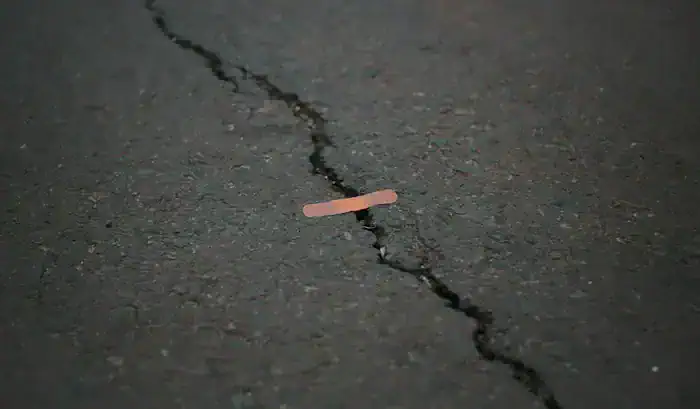
A few cracks in an HOA parking lot or private road may not look like a big deal. They are easy to drive over, easy to ignore, and usually do not seem urgent.
But cracks are often one of the first signs that an asphalt surface needs attention.
Once cracks open, rainwater can work its way into the pavement structure below. Over time, that moisture can contribute to weakened pavement, larger cracks, potholes, and more extensive asphalt repairs.
That is why HOA crack sealing in the Bay Area should be viewed as preventive maintenance rather than just a cosmetic improvement.
For HOA boards and property managers, addressing cracks early can help protect the community’s pavement, improve its appearance, and make future maintenance costs easier to plan.
And there is good reason to pay attention to pavement maintenance right now.
According to data released by the Metropolitan Transportation Commission in November 2025, the Bay Area’s roughly 44,000 lane miles of local streets and roads had an average Pavement Condition Index score of 67 out of 100. That was the tenth consecutive year the regional average remained at 67. MTC describes pavement at this level as being in “fair” condition, with the typical stretch showing serious wear and likely requiring rehabilitation in the relatively near future.
Your HOA’s private streets and parking areas are obviously different from public roads, but the regional numbers highlight an important point: pavement does not take care of itself.
Small maintenance decisions today can have a big impact on what an HOA has to deal with tomorrow.
Asphalt crack sealing is a pavement maintenance process designed to reduce the amount of water and debris entering cracks in an asphalt surface.
The Federal Highway Administration identifies crack treatment as both corrective and preventive pavement maintenance. The basic process involves cleaning appropriate cracks and sealing them with a material designed for the application. One of the main goals is to reduce the intrusion of water and other materials into the pavement structure.
For an HOA, crack sealing may be used on:
Private community streets
Shared driveways
Condominium developments
Townhome communities
Apartment and multifamily properties
Common parking areas
Community access roads
Asphalt around shared facilities
Not every crack should automatically receive the same treatment. The condition of the pavement, movement of the crack, surrounding deterioration, drainage, and underlying structural problems all matter.
That is why a pavement inspection is a smart first step.
Bay Area pavement deals with more than vehicle traffic.
Asphalt is constantly exposed to sunlight, oxidation, temperature changes, water, vehicle fluids, delivery trucks, garbage trucks, resident vehicles, landscaping equipment, and everyday wear.
Eventually, cracks develop.
The important question for an HOA board is what happens next.
One of the biggest reasons to seal appropriate asphalt cracks is water.
When a crack remains open, rainwater has another path into the pavement structure. The Federal Highway Administration notes that crack treatments are commonly used to prevent or substantially reduce water infiltration into asphalt pavement.
Crack sealing cannot magically make an aging pavement new again, and it cannot eliminate every possible source of moisture. It is one tool within a larger pavement maintenance strategy.
But reducing surface water infiltration is one reason crack sealing has been used for decades as a preventive pavement maintenance treatment.
For an HOA, that can mean addressing a manageable maintenance issue before residents are calling the property manager about potholes or badly deteriorated pavement.
The latest MTC data gives HOA boards some useful regional context.
In November 2025, MTC reported that the Bay Area’s regional pavement score remained at 67 out of 100. MTC also notes that the region’s average is getting relatively close to a PCI score of 60, a point at which pavement deterioration can accelerate rapidly.
That does not mean every HOA road in the Bay Area has a PCI of 67. Private HOA pavement is not what this regional public-road statistic measures.
Instead, it shows the broader challenge facing asphalt throughout the region.
For HOA boards, the takeaway is simple: waiting until pavement visibly fails is rarely a good maintenance strategy.
A crack is not automatically a pavement emergency.
But it is worth investigating.
An untreated crack may continue to expand as the pavement moves and ages. Water can enter the opening, surrounding pavement can deteriorate, and eventually an area that may once have been a candidate for preventive maintenance may require a more involved repair.
Potential problems can include:
Wider or interconnected cracking
Water entering the pavement structure
Potholes
Loose or deteriorating asphalt
Depressed or failed areas
More extensive asphalt patching
Premature resurfacing needs
Larger future maintenance projects
The goal of HOA pavement maintenance is not to promise that cracks will never return. Asphalt naturally ages.
The goal is to identify problems early and use the right treatment at the right time.

The terms “crack sealing” and “crack filling” are sometimes used interchangeably, but technically they can refer to different treatments.
The Federal Highway Administration describes crack filling as generally placing bituminous material into nonworking cracks to reduce water infiltration. Crack sealing can involve more preparation and is often associated with cracks that experience movement.
The right treatment depends on the crack and pavement condition.
Crack sealing is generally intended for cracks where movement is expected. Preparation and the type of sealant used are important because the material needs to perform as the pavement moves.
Crack filling is generally used for less active or nonworking cracks. The objective is still largely preventive: reduce water infiltration and slow additional deterioration.
For an HOA board, you do not necessarily need to diagnose every crack yourself.
A paving contractor should evaluate the pavement and recommend the appropriate treatment based on what is actually happening.
A professional crack sealing project should start before the sealant comes out.
The first step is determining the overall condition of the asphalt.
A contractor may look at:
Crack patterns
Crack severity
Drainage
Potholes
Failed asphalt
Surface oxidation
Previous repairs
Traffic patterns
Areas showing structural deterioration
This helps separate cracks that may benefit from sealing from areas that need a different type of asphalt repair.
Preparation matters.
Loose debris, dirt, vegetation, and other contaminants can interfere with the treatment. FHWA guidance describes cleaning cracks as part of routine crack treatment before sealant is applied.
Depending on the crack and pavement conditions, an appropriate sealing or filling material is applied.
The material and installation method should match the conditions of the pavement. FHWA research notes that crack sealing performance can depend on factors including sealant properties, installation methods, temperature extremes, traffic levels, pavement condition, and crack movement.
Crack sealing is rarely the only pavement maintenance an HOA will ever need.
Depending on the property, a longer term plan might include:
Regular pavement inspections
Crack sealing
Asphalt patching
Pothole repair
Sealcoating
Striping
Drainage corrections
Resurfacing
Asphalt replacement
The advantage of a plan is that the HOA can prioritize work instead of reacting every time a new pavement problem appears.
This is another common source of confusion.
Crack sealing and sealcoating are not the same service.
Crack sealing treats appropriate openings in the asphalt and helps reduce water and debris entering those cracks.
Sealcoating is applied over a broader asphalt surface. It can help protect asphalt from oxidation, sun exposure, water penetration, and other surface wear while also giving older asphalt a cleaner, more uniform appearance.
For many HOA properties, crack repair or crack sealing is completed before sealcoating.
Think of it this way:
Crack sealing addresses specific openings.
Sealcoating addresses the pavement surface.
Neither is a substitute for repairing pavement that has already structurally failed.
This is an important question for HOA boards because there is a point where preventive maintenance is no longer the appropriate answer.
If an area has severe interconnected cracking, deep potholes, base failure, major settlement, or widespread structural deterioration, simply putting sealant into the cracks will not repair the underlying problem.
Those areas may require:
Asphalt removal and replacement
Full depth repairs
Patching
Milling
Resurfacing
Drainage improvements
More extensive reconstruction
A reputable Bay Area paving contractor should be willing to tell an HOA when crack sealing makes sense and when it does not.
Spending money on the wrong treatment is not preventive maintenance.
A good habit is to inspect HOA pavement regularly and after periods of heavy weather.
The exact maintenance schedule will depend on the age, condition, drainage, traffic, construction, and previous maintenance history of the property.
HOA boards and property managers should keep an eye out for:
New cracks
Existing cracks getting wider
Standing water
Potholes
Crumbling pavement edges
Loose aggregate
Depressions
Faded or oxidized asphalt
Failed patches
Drainage problems
You do not need to wait until the annual budget meeting to notice these issues.
Take photos, record locations, and track whether the problem is changing.
That information can also help your paving contractor understand how quickly an area is deteriorating.
When practical, addressing appropriate cracks before extended wet weather can make sense because one of the primary purposes of crack treatment is reducing water infiltration.
That does not mean there is one universal “crack sealing month” for every HOA in Northern California.
Weather, pavement temperature, surface conditions, the sealant being used, and the scope of work can all affect scheduling.
Instead of waiting for the first major storm to think about pavement, property managers can make pavement inspections part of their planning process earlier in the year.
A simple HOA pavement checklist might include:
Inspect private roads and parking areas
Photograph developing cracks
Identify potholes or failed areas
Check drainage and standing water
Request a professional pavement assessment
Separate immediate repairs from preventive maintenance
Budget future phases of work
That is much easier than trying to organize a major pavement project after problems have already accelerated.
One of the biggest mistakes an HOA can make is viewing pavement maintenance as a series of unrelated repair bills.
Private streets and parking lots are long term community assets.
A better approach is to create a pavement maintenance strategy that looks several years ahead.
Instead of discovering a major paving expense unexpectedly, the board can identify likely future needs and begin planning for them.
For example, a pavement plan might identify:
Failed asphalt repairs
Potholes
Drainage problems
Safety concerns
Crack sealing
Minor repairs
Sealcoating
Striping
Resurfacing
Larger asphalt replacement
Major rehabilitation
This allows an HOA to distinguish between pavement that needs attention now and pavement that simply needs to be monitored.
You do not need to be a paving expert to ask good questions.
When walking your property, look for these signs:
Are cracks becoming longer or wider?
Are multiple cracks connecting?
Is water collecting near cracked areas?
Are potholes starting to develop?
Is asphalt breaking apart around drains?
Are previous patches failing?
Are parking areas showing heavy wear?
Are private streets cracking near their edges?
Is the pavement noticeably faded or oxidized?
When was the property’s last professional pavement inspection?
Does the HOA have a multi year pavement maintenance plan?
If you cannot answer the last two questions, those are good places to start.
Bay Area HOA communities come in many forms.
A large condominium development in San Jose may have private streets, parking stalls, fire lanes, and multiple entrances. A smaller townhome association may only be responsible for a private driveway and shared parking area.
The maintenance strategy should fit the property.
Calvac Paving works with commercial properties, property managers, HOAs, and other organizations throughout the San Francisco Bay Area.
Our goal is to evaluate the actual condition of the pavement and recommend the appropriate next step rather than treating every property the same way.
Calvac Paving has been serving the Bay Area since 1974.
That means more than 50 years of experience working with Bay Area asphalt, commercial properties, parking lots, private roads, and pavement maintenance projects.
For HOA boards and property managers, experience matters because pavement work affects residents, parking, vehicle access, schedules, and community budgets.
Calvac Paving can help evaluate pavement conditions and develop a practical approach that may include crack sealing, asphalt repair, sealcoating, striping, or larger paving work depending on the needs of the property.
Rather than waiting for cracks to become major pavement failures, HOA boards can take a proactive approach and understand what their asphalt needs now and what can wait.
There is no single schedule that applies to every HOA. Pavement age, existing condition, traffic, drainage, weather exposure, and previous maintenance all affect how often cracks need attention.
Regular inspections are more useful than relying on an arbitrary calendar. If new cracks appear or existing cracks begin changing, have them evaluated.
When the pavement and cracks are suitable for the treatment, crack sealing can be an important part of preventive asphalt maintenance.
FHWA recognizes crack sealing as a preventive maintenance activity, with reducing water infiltration being one of its primary purposes.
It will not repair structural pavement failure, so proper inspection is important.
Crack sealing cannot guarantee that a pothole will never develop.
However, water entering cracks can contribute to pavement deterioration. Reducing water infiltration is one reason crack treatment is used as preventive maintenance.
If an area is already failing structurally, it may require asphalt repair rather than crack sealing alone.
Appropriate cracks and pavement failures generally need to be addressed before a broader surface treatment is applied.
Crack sealing and sealcoating perform different jobs, so an inspection should determine what preparation is necessary before sealcoating.
Crack sealing treats appropriate cracks in pavement.
Asphalt repair generally addresses areas where the pavement itself has deteriorated or failed and may require removing damaged asphalt and replacing it.
If the base or pavement structure is failing, crack sealant alone will not solve the problem.
Weather and surface conditions matter when applying pavement maintenance products. Your paving contractor should determine whether conditions are appropriate for the specific material and application.
Planning ahead of prolonged wet weather can give an HOA more flexibility when scheduling preventive maintenance.
Yes. Crack sealing can be part of a preventive maintenance program for private HOA roads when the cracks and pavement are appropriate for the treatment.
Private roads should still be professionally inspected because some cracking can indicate underlying pavement problems that require more extensive repair.
Yes. Calvac Paving works with HOAs, property managers, commercial properties, and other organizations throughout the Bay Area.
Services can include asphalt paving and repair, crack sealing, sealcoating, striping, and other pavement maintenance work depending on the needs of the property.
Calvac Paving has served the San Francisco Bay Area since 1974, giving the company more than 50 years of local paving experience.
Calvac Paving offers a two year workmanship warranty on qualifying work. Specific warranty coverage depends on the project and should be confirmed as part of your proposal.
Yes. An inspection is one of the best places to start.
Instead of assuming every crack needs the same treatment, Calvac Paving can evaluate the pavement and help identify areas that may be candidates for preventive maintenance versus areas that need more substantial asphalt repair.
Cracks are easy to ignore.
Unfortunately, pavement deterioration rarely gets better on its own.
The Bay Area’s latest regional pavement data is a useful reminder. MTC reported in 2025 that the region’s average pavement condition remained at 67 out of 100 for the tenth consecutive year, and the agency warns that deterioration can accelerate as pavement approaches lower condition levels.
HOA boards cannot stop asphalt from aging, but they can decide how proactively they manage it.
Regular inspections, timely crack sealing, asphalt repairs, good drainage, sealcoating when appropriate, and long term pavement planning can help an HOA stay ahead of deterioration instead of constantly reacting to it.
If you manage an HOA, condominium community, townhome development, private road, or multifamily property in the San Francisco Bay Area, Calvac Paving can help you understand the condition of your pavement and determine the right next step.
With more than 50 years serving the Bay Area, Calvac Paving provides asphalt paving and pavement maintenance solutions built around the needs of each property.
Do not wait for a small crack to become the community’s next big maintenance problem.
Contact Calvac Paving to schedule an HOA pavement evaluation and start planning for the road ahead.
2645 Pacer Ln
San Jose, CA
95111
(408) 225-7700